Application Open: Richman Undergraduate Exploration Fellowship through SF State CREATE
A new SF State CREATE fellowship supporting curiosity, exploration, and discovery across all disciplines
SF State CREATE is pleased to launch the Richman Undergraduate Exploration Initiative, a new campuswide fellowship supporting undergraduate research, scholarship, and creative activity at San Francisco State University.
The Richman Initiative is designed to give students something that can be difficult to find while balancing college, employment, family responsibilities, and other commitments: protected, paid time to explore.
Richman Fellows will work with an SF State faculty mentor to pursue a research, scholarly, or creative project that gives them an opportunity to ask questions, follow their curiosity, and experience the wonderment, joy, uncertainty, and discovery at the heart of creating new knowledge and new work.
The program is open to undergraduate students in all majors and disciplines. Projects might take place in a laboratory, archive, studio, community, classroom, field site, library, performance space, or other setting appropriate to the discipline. Research and creative inquiry take many forms, and students in all majors and disciplines are encouraged to apply.
SF State CREATE defines research, scholarship, and creative activity broadly as hands-on investigative, experiential, scholarly, and creative work through which students generate knowledge, express creativity, and contribute to their disciplines, communities, and future careers.
Fellowship at a Glance
Richman Fellows receive:
- A $2,000 fellowship, paid in two installments
- Approximately 100 hours of faculty-mentored research, scholarship, or creative activity
- An SF State faculty research/creative mentor
- A cohort-based professional development experience through SF State CREATE
- Opportunities to build skills, explore academic and career pathways, and learn to communicate their work
- Participation in the Richman Fellow Showcase on May 14, 2027
- Participating faculty mentors will receive a $500 mentor stipend and participate in a brief Richman mentor orientation.
Informational Sessions
SF State CREATE will hold two informational sessions on the application process on September 15 from 12-1pm in LIB 260 (DMS/MakerSpace) and September 21 from 12-1pm online. Please register here
Important Dates
| Informational Session (online) | September 21, 2026 |
| Informational Session (in-person) | September 30, 2026 |
| Student application deadline | October 12, 2026 |
| Applicants notified | October 19, 2026 |
| Fellowship begins | November 13, 2026 |
| Faculty mentor orientation | November 13, 2026 |
| First fellow cohort meeting | November 13, 2026 |
| Fellowship period | November 13, 2026-May 14, 2027 |
| Richman Fellow Showcase | May 14, 2027 |
Who Should Apply?
The Richman Undergraduate Exploration Initiative is intended for SF State undergraduates who are curious about a question, problem, idea, or creative possibility and would benefit from the time and mentorship to explore it more deeply.
Prior research experience is not required.
Students who have never participated in research, scholarship, or creative activity are encouraged to apply alongside students who already have some experience.
Applicants should:
- Be currently enrolled SF State undergraduate students and remain enrolled during the fellowship period.
- Identify an SF State faculty mentor before applying.
- Develop a feasible research, scholarly, or creative project with that mentor.
- Be able to devote approximately 100 hours to the project between November 13, 2026 and May 14, 2027.
- Be able to participate in required monthly Friday Richman cohort meetings.
- Participate in the Richman Fellow Showcase on May 14, 2027.
The fellowship is intended to support student learning and exploration rather than simply reward previous accomplishments. Students do not need to have an extensive research record to be competitive.
What Kind of Project Can I Propose?
Projects may involve research, scholarship, creative activity, or combinations of these approaches.
A project may be:
- Developed primarily by the student with guidance from a faculty mentor, or
- A meaningful student-led or student-owned component of a faculty mentor's larger research, scholarly, or creative project.
In either case, the applicant should have a substantive intellectual or creative role rather than simply completing routine tasks.
A successful project does not need to guarantee a particular result. Exploration, iteration, uncertainty, unexpected findings, revision, and even ideas that do not work as anticipated are all part of research and creative inquiry.
We are interested not only in what you hope to produce, but in what you hope to discover, learn, and become able to do through the process.
Before You Apply: Identify a Faculty Mentor
Students must identify an SF State faculty mentor before submitting the application.
Talk with a faculty member whose research, scholarship, creative activity, or expertise relates to your interests. Together, discuss:
- The question, idea, problem, or creative possibility you want to explore
- What you will actually do during the fellowship
- What part of the project will be yours
- What training or preparation you may need
- What can reasonably be accomplished in approximately 100 hours
- How and how often you will meet
- Any approvals, equipment, facilities, materials, or other resources the project may require
Your faculty mentor must review your proposal and complete the Faculty Mentor Agreement and Endorsement Form.
You will upload the completed and signed form as part of your application.
Application Guidelines
Applications must be submitted through the Richman Undergraduate Exploration Initiative Qualtrics application by October 12, 2026.
APPLY FOR THE RICHMAN UNDERGRADUATE EXPLORATION INITIATIVE
You will be asked to provide the following information.
1. Student Information
Basic information including your name, SF State email, Student ID, major/program, class standing, and expected graduation date.
You will also be asked about your previous experience with research, scholarship, or creative activity. Having more previous experience does not make an applicant more competitive. This information helps reviewers understand where you are starting.
2. Faculty Mentor Information
Provide your mentor's name, department/program, and SF State email address.
You will confirm that you have discussed the project with your mentor and that they have agreed to mentor you if you are selected.
Your Project Proposal
Write your proposal for an educated reader who may not be familiar with your field. Avoid unexplained disciplinary jargon.
Reviewers should be able to understand what you are exploring, what you will do, why the project interests you, and what you hope to learn.
3. Project Title
Provide a concise title describing your proposed project.
4. Project Question or Goal
In approximately one or two sentences, describe the central question, objective, or creative goal guiding your project.
5. Project Plan and Your Role - Maximum: approximately 500 words
Describe the background or context for the project; your specific question, objective, or creative goal; the methods, activities, or creative approach you will use; what you will actually do during the fellowship; and your individual intellectual or creative role. If your work is part of a larger faculty project, clearly identify the portion that you will own, lead, or substantially contribute to. The project does not need to guarantee a particular result. Reviewers want to understand what you plan to do and why the approach makes sense.
Wonderment, Curiosity, and Discovery
6. What Are You Curious About? - Maximum: approximately 150 words
What are you most curious about in this project?
What draws you to this question, problem, idea, or creative possibility? What do you hope to discover, understand, make, or experience - even if you do not yet know where the process will lead?
There is no expectation that you already know the answer. Wonderment and uncertainty are part of the research and creative process.
Learning and Exploration
7. What Do You Hope to Learn? - Maximum: approximately 150 words
What do you hope to learn or become able to do through this fellowship? How might the project and relationship with your faculty mentor help you explore your academic interests, creative interests, career possibilities, graduate or professional school interests, or personal or intellectual development?
Why Does Paid Time Matter?
8. Protected Time for Exploration - Maximum: approximately 150 words
The Richman Fellowship is intended to provide students with protected, paid time for exploration and discovery.
How would receiving the $2,000 fellowship affect your ability to devote time and attention to this project?
You may discuss paid employment, commuting, caregiving, family responsibilities, or other commitments if they are relevant, but you are not required to disclose private financial information.
We are interested in understanding what opportunity the fellowship would make possible for you.
The need for paid opportunities is central to the Richman Initiative. Many SF State students balance their studies with substantial employment and other responsibilities, making unpaid experiential opportunities difficult or impossible to pursue. The program was created specifically to help make discovery-based work more accessible.
Contribution and the Greater Good
9. Why Might This Work Matter? - Maximum: approximately 100 words
Who might benefit from this work, and how? You may discuss how the project could contribute to knowledge or understanding, a scholarly or professional field, creative practice, a community, public dialogue, education, health or wellbeing, technology or innovation, culture, the environment, or the greater good in another way.
Not every project needs to be community-engaged. Answer this question in a way that is meaningful and appropriate for your discipline.
Project Feasibility
10. Timeline
Briefly describe how you expect to organize approximately 100 hours of project work between November 13, 2026 and May 14, 2027. Identify major activities or milestones.
11. Preparation and Training
Describe any skills, coursework, previous experience, or preparation that will help you begin the project. You do not need to arrive knowing how to do everything required for the project. Also identify skills, techniques, methods, or creative practices that your mentor will help you learn.
Research Approvals and Project Resources
You will be asked whether your project may involve:
- Human participants
- Vertebrate animals
- Laboratory or other safety requirements
- Other institutional approvals or required training
Students and faculty mentors are responsible for ensuring that all required approvals and training are completed before the relevant research activities begin.
Faculty Mentor Agreement and Endorsement
Before submitting your application, your mentor must complete and sign the Richman Faculty Mentor Agreement and Endorsement Form.
The form asks your mentor to confirm:
- Their willingness to mentor you throughout the fellowship
- That the proposed project is feasible within approximately 100 hours
- That you will have a meaningful intellectual or creative role
- Their plans for meeting with, training, and providing feedback to you
- Their participation in the November 13, 2026 faculty mentor orientation
- Their support for your participation in the Richman Fellow Showcase
Faculty mentors receive a $500 stipend for their participation.
You must upload the completed form as a PDF before you can submit your application.
Fellow Expectations
Being selected as a Richman Fellow means joining a cohort, not simply receiving an individual award.
In addition to completing approximately 100 hours of project work with your faculty mentor, fellows are expected to participate in monthly Friday professional development meetings led by SF State CREATE.
Topics will include:
- Navigating research and creative cultures
- Understanding "how research works"
- Developing a research, scholarly, or creative identity
- Finding belonging and addressing impostor feelings
- Ethical research and community accountability
- Communicating and presenting your work
- Graduate school and career pathways
- Translating research and creative experiences into future opportunities
- Considering how scholarship and creative work can contribute to the public good
These cohort meetings are required for Richman Fellows. The first meeting will take place on Friday, November 13, 2026.
Richman Fellow Showcase
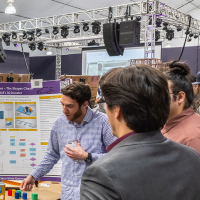
All fellows will share their work at the Richman Fellow Showcase on Friday, May 14, 2027.
Depending on the discipline and project, students might present their work through a:
- Research poster
- Oral presentation
- Creative exhibition
- Performance
- Demonstration
- Digital or multimedia project
- Other discipline-appropriate format
Students will also be encouraged to present their work at college or campus showcases and, where appropriate, at professional conferences.
Ready to Apply?
Applications must be submitted by October 12, 2026.
Applicants will be notified of fellowship decisions by October 19, 2026.
Apply: RICHMAN UNDERGRADUATE EXPLORATION INITIATIVE APPLICATION
Download: FACULTY MENTOR AGREEMENT AND ENDORSEMENT FORM
Questions? Contact Dr. Kate Hamel, Faculty Director for Research Engagement and Development, SF State CREATE, at hamelk@sfsu.edu.
Related News